A Bombing memory

A Bombing memory

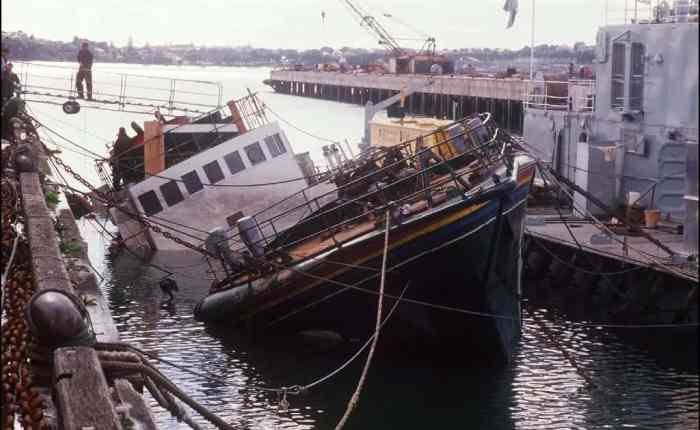
A day or two after the bombing of the Greenpeace vessel Rainbow Warrior 40 years ago on 10 July 1985, I was asked to join the police investigation team to “help with exhibits”. I was a young uniformed constable and had been noticed by someone up high as I had been fortunate enough to do 3 or 4 months of “CIB Secondment”, swapping duties with a seasoned detective (who was unimpressed as I recall). During that secondment period I’d worked on the Auckland enquiries of the Wellington Trades Hall Bombing, a crime unsolved to this day (I hope it wasn’t my fault!).

I took the grand title of 2 i/c exhibits and regarded myself then (and now) as the most junior member of the 66 strong investigation team on the Rainbow Warrior investigation. Bits of sodden objects from the ship and pieces of the its hull were catalogued, labelled and logged into the Whanganui Computer’s exhibits system. All green and grey screens and moving between tabs like a 1980s game of Loadrunner. Using a computer system to log exhibits was very new, in fact it was only the second time the module had been used. We took possession of the Zodiac boat, diving tanks, and dozens of receipts for daily living found in the campervan along with hundreds of other items. Giant drying machines operated 24/7 to dry out the sea soaked items.

Somehow, when the exhibits stopped coming in and didn’t require much attention, I got to stay on with the much smaller investigation team while we refined the evidence readying it for trial, closing loose ends. I completed a tour of Northland, logging the spots in the Kaipara Harbour and further north to identify where the two agents had travelled to and taken photographs that were found in the campervan. I was fortunate to be able to board and view the ship while it was in dry dock at the Devonport Naval Base.

I marvelled at the diving gear, new and abandoned, and appeared on the front page of the New Zealand Herald with the outboard motor from the Zodiac. One of the final acts was going to court for the depositions hearings (to be held at the specially reopened old High Court building in Waterloo Quadrant) to discover at the same time as members of the public that a deal had been done for the two agents to plead guilty to manslaughter, the Crown withdrawing the murder charges laid.
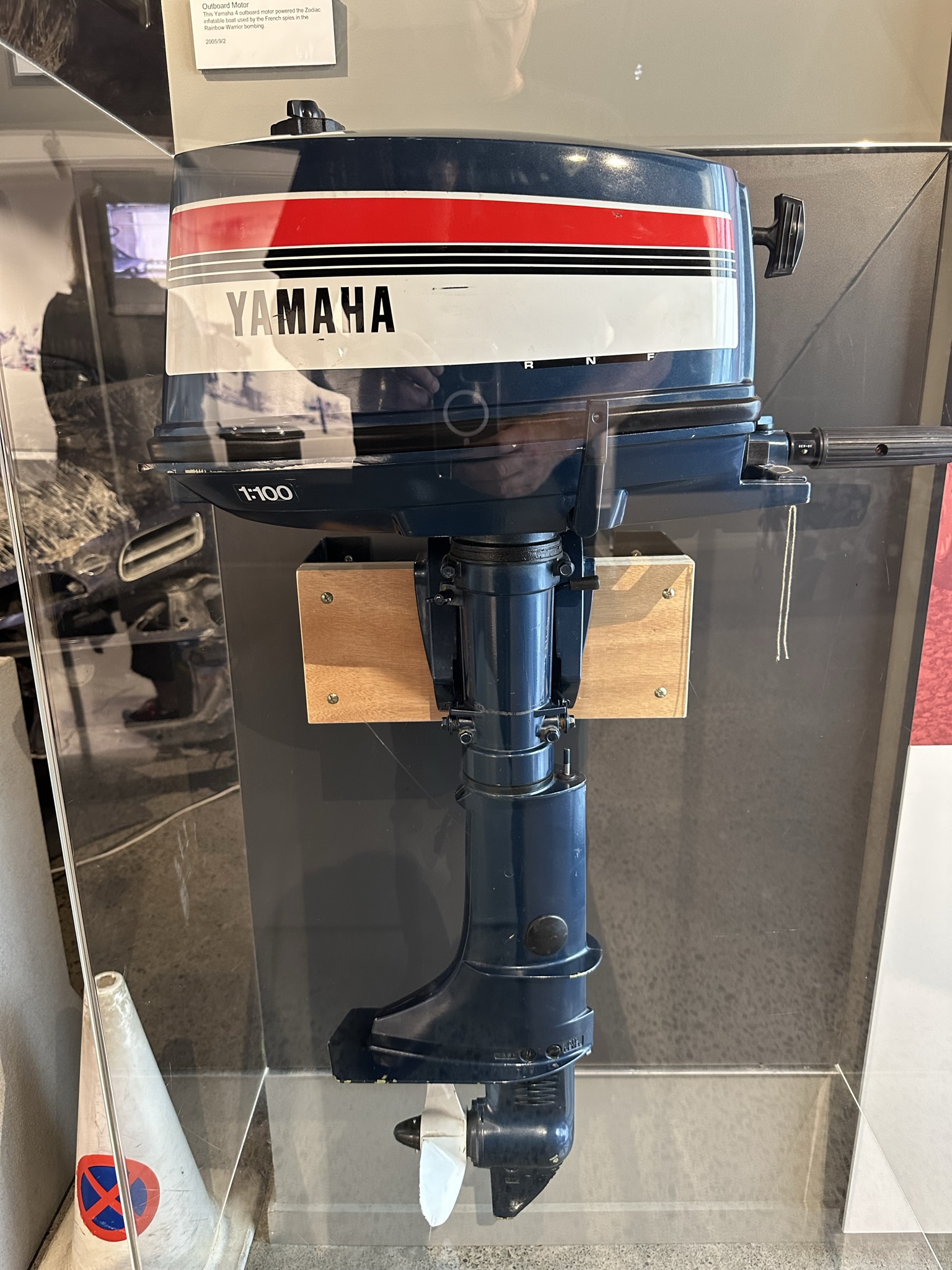
The Outboard motor from the Zodiac used by the agents who planted the bombs on the hull of Rainbow Warrior. Now at the Police Museum.

I didn’t return to full time uniform duties. It was CIB from then on, and then Serious Fraud Office. Cops love to claim successful investigations (“that was my job” you’ll hear) and this was by no means mine, but it was a deep learning experience and shaped much of the investigation work I later and still do. How to manage exhibits, chain of evidence, looking at evidence dispassionately but considering context – only a civil servant would keep receipts like that for claiming it was said – which was correct of course, and what it means to turn over every stone.

As I read this blog back just now I realised I had gone back in time in my mind, with many of the details from this period as fresh today as they have always been. My purpose in this blog is to reflect on a period of learning that shaped me during a historical moment. But I have never forgotten that a man died – Fernando Pereira – who should have recently turned 75. I hope that those who cared about Fernando are at peace over this tragic event.

Stephen

Photos: Banner AFP Photo:Patrick Riviere, Outboard Stephen Drain

Just like riding a ski

Just like riding a ski

I’ve been fortunate enough to see if I could ski again after a bit of chop and change in one of my legs a couple of years ago. No one was more surprised than me when I gave it a go at Coronet Peak a few weeks ago, and I managed a few runs, backed up a fortnight later.

I found myself telling people I could still ski thanks to a special ski week quite some time ago and it got me thinking about that ski week.

Back in the school holidays in the sixth form (year 12 now) I spent a glorious week learning to ski properly at Mt Olympus Ski field near Lake Coleridge, Canterbury with a group of school boys. It now promotes itself as the place to “Ski in the Playground of the Gods“. It was a big week.

We got dropped off at a Canterbury Farm Station somewhere, and me and three other boys were driven up in the couple’s two door Range Rover. I assumed they operated the Station, but at that age, you don’t know much really, and I didn’t ask, or was told. Mind your own business my mother would have said anyway! They were club members I do recall, and I can see that the club is still running the field – the Windwhistle Winter Sports Club – as it has since 1932. I’ve had a thing for skiing and those early Rangies ever since.

Then there was no milk and I started drinking black coffee which tasted quite bitter and was instant – I think that was “normal” then – but I’ve been a black coffee drinker ever since. And on the first day of skiing the instructor told us “leave your poles boys, you’ll be learning to ski properly”. And we did.

So when I thought I’d give skiing a go at Coronet Peak with limitations to my leg I found I could. What came straight back to guide me were the lessons at Mt Olympus, coming sharply back into focus. Shifting the weight from ski to ski to turn. Poles just for balance.

It’s worth learning something properly. It stays.

Stephen

The original Range Rover was introduced by British Leyland under the Rover brand in 1969 and continued in production until 1996, by then under the Land Rover brand. It was a two-door model until 1981. You’ll see restored two door models for sale in NZ for ~$50,000 and a lot more overseas.

Changing Development

We’ve been running the Authentic Leadership Programme for almost a decade. It’s never stood still and if you attended one of the early programmes when I was at AUT you’d notice many changes from those days.

iStock-813786528.jpgRelevancy is a word we are increasingly using in business and leadership development must remain relevant, to be relevant.

Leadership development is a nice to have at many organisations and even though I’m in the development business, I’m not surprised.

Facilitators without any authentic leadership experience themselves, dried out old case studies straight out of a 1980s MBA, lecturing and bring ’em down to build ’em up nonsense all make potential participants question the true value.

So what changes have we been done lately? Learning conversations with senior leaders led by the participants themselves, micro-coaching sessions on the way through, location, location, location – context driven locations for learning – like on a tram for transport leaders hearing early stories of trams in Auckland.

We’re reshaped the reflection process putting it out in front of everyone with ReflectBack™, enhanced our Blueprints with time on Programme to complete, share and reflect with.  We’ve embraced client direct participation on the programme. After all, we’re not running a secret society and we’re confident enough in what we do that we’re very proud for our clients to see close up the development we’re providing for their managers.

And we’re using technology – an App to stay connected and share practical details throughout – and running in-between sessions via electronic methods sometimes.

The next edition of the Authentic Leadership Programme will be different – we try and learn as we go – keeping the Programme relevant for the new context, and at the same time providing us with new energy to try new things out.

You don’t always know where it’s going to go, but hey, that’s leadership isn’t it?

Stephen

A Leadership Word

The final session of the Authentic Leadership Programme was a round of words. What word will finish the Programme for you we asked.

iStock-685797112.jpgI didn’t capture all the words but most of them.  Whether I can make a blog out of them remains to be seen but I thought it would be good to share a very powerful session.

Cheating in Cricket wasn’t known about at the session, but Ethical Compass and Legacy have startling relevance right now. Not just in sport leadership but in our behaviours as leaders in the work place.

When the team is under pressure, our strategies for Resilience pre-prepared will need to come into play, as will our Humanity and, well just being the best Human we can be.  For me, there are times that the key strategy is Grit.  A vital attribute for any leader.

That doesn’t mean losing sight of our Emotional Intelligence recognising that tough times can lead to the best Learning.

Leaders need to be Confident with their Authenticity, show Vision, Empowerment and ask “What’s Next?“.

I got there!

Stephen

ps there’s about 5 more words from the session which I can add in if I get them