Letting go to grow

It felt hard when I got home. We had celebrated my son Thomas’ 21st at Iguacu in Parnell. A lovely evening which included some healing. I wrote quite a lot in a journal in the 90s and had a collection of memorabilia from home and school that captured the moment. It amazed me how much you forget. So if your kids say something like “When you die and come back as another person do you remember who you were?” then write it down. It’ll be worth it. And it was.

Putting together an album of photographs covering 21 years – and really only snippets which is why I called it “The unauthorised and completely random photo album to Thomas from Dad” – I went though the journals, the photographs and the large container of memorabilia. What it came down to were 30 pages. It took a bit of time, but then it felt thin and not worthy of such a fine young man. But it was a representation of 21 very special years of growing up.

I’ve regarded Thomas as grown up for quite some time but when I got home after the dinner it suddenly hit me: now it’s real, I’ve given him all I can to him as a young person. I consoled myself that I can give him (I hope) plenty man-to-man.

Such an empathetic, energetic and optimistic person is a rare find, and Thomas is one.

I’m still slightly sad, not sure why, but I’ve let go in a way I hadn’t expected to feel on Saturday.

Time to grow. For us both.

Stephen
Hitting the spot

I had two significant conversations last week talking about authenticity and meaning in our work. We don’t always see the obvious. Someone who presents as confident, capable, even strategic can be as empty as can be. Yes, full of the right words, strategic linkages, linear flows and other deliberately important but shallow phrases. They might have an important job, looking after many people and a major division and a family who’s on the fast track to societal bliss.

And it may be perfect. But it may also be that you feel something is not congruent. As one of my colleagues said, “there’s nothing in here”, stabbing his heart. I remember being a cynical boy listening to stuff at a religious service about loving with all your heart and thinking “isn’t this just an organ that pumps blood!”.True, but we also now know that the wiring in our bodies is as big in our brains as it is in our gut. A gut feeling then perhaps, though that’s not the entire point of this.

If your organisation is only focussed on a limited range of number-driven KPIs then what? Happy investors? Possibly, but can the numbers only come from looking at the numbers? If you’re reading this then you probably don’t think so, but I challenge you to ask yourself if there aren’t times when the leadership and authenticity that drives business success is put to one side, because we really need to focus on the numbers. Maybe that always happens. If it’s true that corporate spending on leadership development slows during a recession, then that’s evidence enough I reckon. Say it again, spending on leadership development slows during a recession. That’s okay, but don’t pretend you think leadership development is a key driver of success. The manager with no heart has taken over. And a body without a heart is well, stuffed really, the brain will soon die along with all the other organs. And you won’t even know if you’re bleeding without a heart.

Enough of the metaphor! When I engage with an authentic person who has meaning in their life I know it and I can connect, whatever they do. Can you? Look around you at work. Who hits the spot?

Are you leading with something in the spot? That something is everything you are. A happy authentic space.

Stephen

Oh the joy of running!

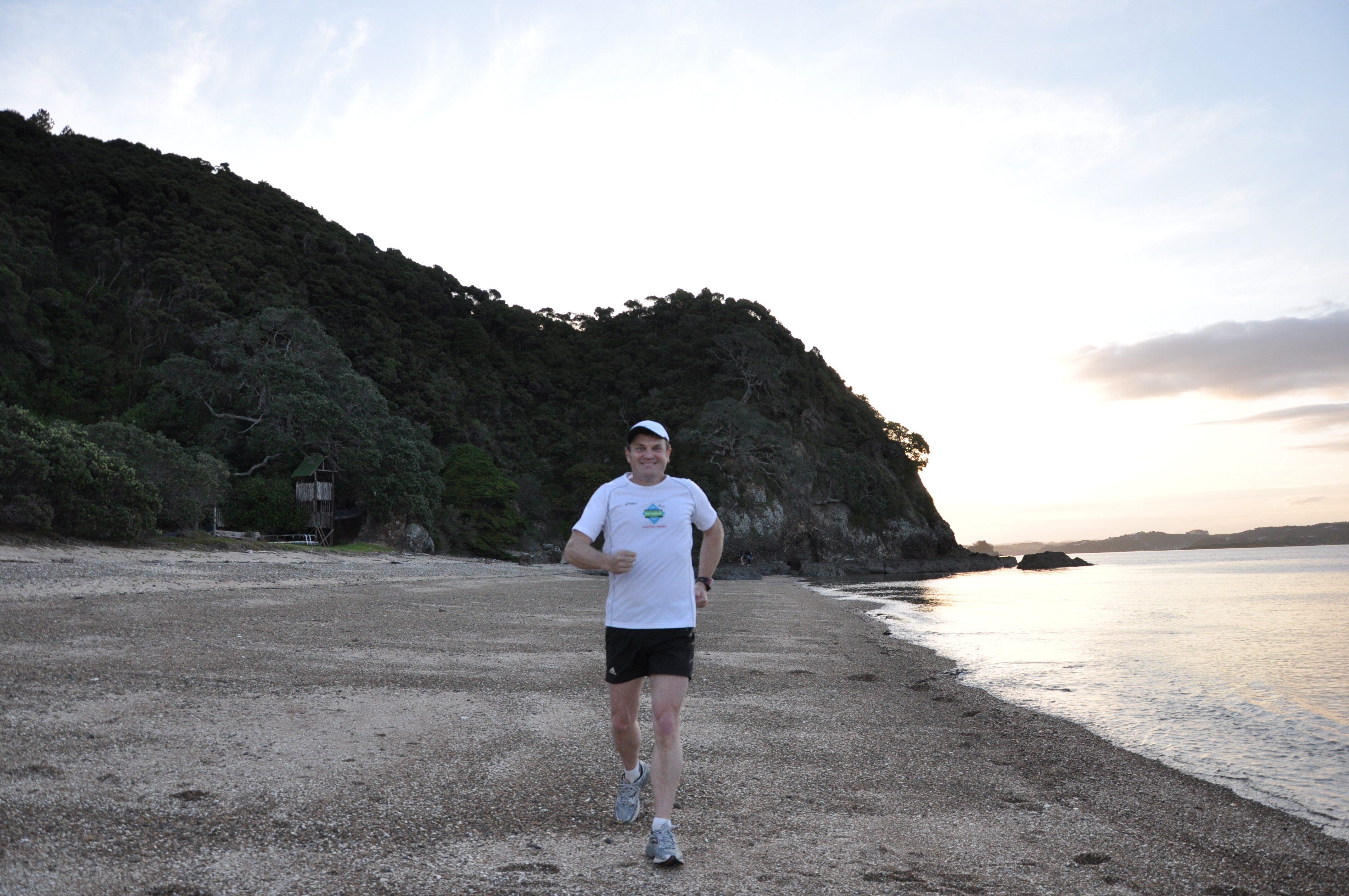
On 23 January 2005 I went out one morning and walked three power poles, ran three, walked three and a bit more until I had completed about 2 kilometres. It was a bit off and on the first year, but nearly 9000 kilometres later (well 8916 to be exact!) I do if asked, call myself a runner. I’m not fast, but I’m not too slow when I apply myself and in those six years I’ve completed 12 marathon events and my average run length went from 6km in 2005 to 15km in 2010.

It’s often hard but I’ve kept going with lots of support – especially from Michael Simons who I’ve mentioned before – and the other regulars on Monday and Wednesday: Julie, Maria and Froste. Mum and Dad have almost always been there to face my mid-marathon abuse! And recently my son Tim took the ferry to Waiheke to see me complete the Wharf2Wharf.

I’ve learned a lot about myself through running:  the space to reflect when going solo, pushing myself really hard to see what I am capable of, encouraging others and being encouraged when the going gets tough and of course a bit of healthy competition to make you go that little bit harder.

I’ve discovered a lot about our great city – you see so much when you’re running that you miss in the car or bus. Running knows no boundaries and the legs work just as good or bad in Marine Parade Herne Bay as they do in Massey Road, Mangere.

When I ask myself: what makes me a leader?, running is an important part of it. In fact it’s got many of the components of leadership in one neat package:  self awareness, communication, reflection, role-modelling, mental & physical toughness and resilience, it’s fun, builds teamwork and is eco-friendly.

Looking forward to the next six years.

Stephen

Does being authentic mean you can do anything?

At the end of the year WordPress, who host this blog, send me some statistics about the site, including how many visitors I’ve had, how many blogs I wrote, what the most popular pages and posts were, and what searches people use to find their way to the site.

The most common searches were stephen drainstephen drain autnegative leadershipnegative leadership traits, and rubik’s cube. I can understand the first two and last one gets searchers to me as I once wrote a blog mentioning the Rubik Cube (I wonder if I’m what they’re looking for? – all questions but no Rubik solution!). I’ve noticed during the year the regular,

Something so right - New Chum Beach, Coromandel

daily searches that people do for “negative leadership”. I don’t know who they are so I can’t ask.

But it is worth exploring in the context of authenticity. If I’m a negative prick, just because I am, then I’m authentic right? So carry on? If I lead by manipulation as that’s my natural way of doing things, authentic to me if you like, then that’s okay too isn’t it? What if I’m overly reflective and don’t participate in leadership meetings when I don’t feel like it? That’s my authentic self so why should I change?

All wrong I say. Sam Harris in his persuasive TED talk challenges a view that science can have no determination on morals. The same should be strongly asserted for leadership. As we have evolved as a species and developed a greater understanding of the human condition, leadership and happiness we are entitled to reach a scientific consensus on what is appropriate or not in leadership.

I know of leaders who use authenticity as an excuse for primitive behaviours like bullying, manipulation and silence. If nothing else my blog searchers tell me that there’s lots out there that some folk reckon is wrong. Negative.

Discovering and developing our authenticity can not be to the exclusion of growing and evolving ourselves. So if you’re a negative prick, don’t use authenticity as your excuse! Some things are just wrong. And some things are right.

Stephen