Courage

Aibileen and Minny are maids in the movie The Help.  They live in Jackson, Mississippi – as in Johnny Cash and June Carter’s duet of the same name –  in the 1960s.  With segregation enshrined by law, the women raise all the white kids as defacto mothers, while the birth mothers, although raised by the same maids, treat them largely with disdain and, pretty much like slaves.

A courageous young white woman, Skeeter, decides to tell the stories of The Help.  She’s not the only courageous one of course.  Aibileen, Minny and all the other maids who collaborate show exceptional courage against their own immediate interests to tell their stories. Stories of love, hate, of raising numerous kids, of missing out on their own children’s upbringing and of not being able to use the toilets in the house, ‘cos they had the wrong skin colour.

I read an article today about simplicity in leadership. It struck a chord with me, so I’ll keep this blog short and simple.

Being courageous requires doing the right thing, often against self interest and immediate gain or acceptance. Authenticity. What will you do today that is courageous?

Stephen

ps great cars and music in the movie too

Enjoy your life

My friend and colleague Richard Kerr-Bell asked me to write a prologue for his book – Enjoy your Life – coming out on Amazon soon.  Here it is: 

When I clear my mail box at the local superette, if it’s Saturday afternoon there will be a steady stream of punters queuing to buy their lucky lotto ticket and occasionally the proprietor convinces me that I really shouldn’t miss out this week. After all, I could win $10 million!  Who wouldn’t want that?

At the end of four days on a public leadership course we have groups of participants who have a bond so close, a support network so finely tuned to each other, that there are often tears when it’s time to go.  If we can do this in four days, then surely we can do this for ourselves.

Senior leaders who interact with me during my leadership development work present with a range of challenges and opportunities.  In coaching sessions I often hear of the boss who is only consumed by financials, by politics that derail teams and of work structures that just don’t seem right.

I see people striving to get to the top, spurred on by career ambitions from family, colleagues and probably society.  If you’re not going up then you’re not going anywhere, I often hear.

Happiness is a simple concept made very complicated as we confuse the means with the end.  Assumptions that money, position and relationships will give you happiness are just that, assumptions.

All of those things may contribute to your happiness but they will not on their own, or even collectively, give you the happiness that you strive.  If you think that winning a million dollars, or for that matter losing a loved one will have a dramatic long term impact on your happiness, you’re wrong.  Research tells us that most people return to the state of happiness that they existed with prior to such an event, within a year.  One year!

Which should tell us that our state of happiness is more likely to be impacted by our own personal conduct than any external forces.  Put another way, you are responsible for your own happiness.

Being responsible for something means being pro-active, engaged in the process and making changes.  If you’ve read this far then there’s probably a good chance that Enjoy Your Life appealed to you because well, like me, you want to be happy.  But where to start? What to do when it seems life is so complex? 

When Richard asked me to write the prologue for Enjoy your Life I knew that this would be a book rich in stories, quotes and experience. This is why Richard works on our Authentic Leadership programmes.  Because he’s real, has lived and knows a lot more than most people about what it takes to be happy. He knows all those simple things that will make you enjoy your life.

Career and having lots of money might well follow happiness, but the mistake would be to start there.  Start with yourself. After all, no–one can ever have as much interest in your happiness than you. Don’t you owe it to yourself to enjoy your life?

And if you have a niggling doubt that to spend time on your own happiness is selfish, don’t be concerned.  You’ll be pleasantly surprised to find that much of what it takes to be happy is about how you treat others.

In any case, I say you’re allowed to be selfish about your own happiness. In the end if you’re not happy then those around you won’t enjoy your life either. So be selfish and enjoy your life.  What else is there?

Stephen

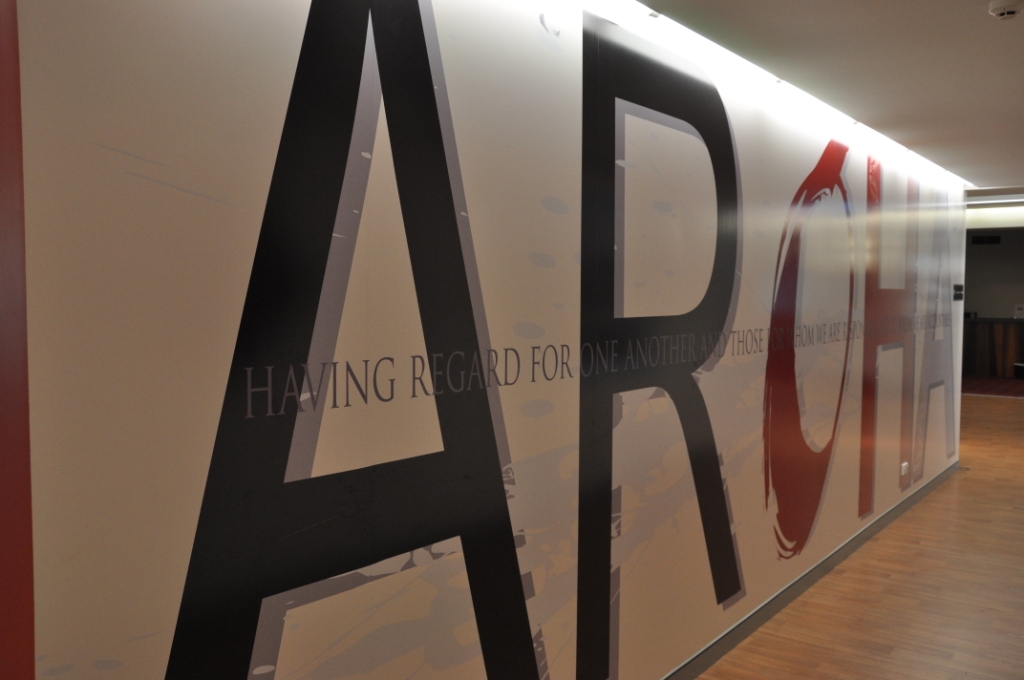
ps here’s a photograph from Te Wananga o Aotearoa in Hamilton. See here for the meaning of Aroha.

Innovative Leadership

That’s the name of the Leadership Centre I look after and sometimes (but not often) I get asked the question:  So what is innovative leadership?We’ve run the inaugural general management programme this year with one module to go – it’s called the Innovative Leaders GM Programme – it’s a special leadership programme with a focus on strategy and business functions. There’s a reason why it’s called the Innovative  leaders programme and that’s tied in with research that says that innovation is the top skill CEOs are looking for. You might be thinking – well I don’t know where to start, or my role is such that the risk needs to be carefully managed so innovation is not for me. Not necessarily.

Leaders who facilitate innovation are as important (and possibly more important) than those that do it.  I try to role-model what we’re aiming to get our participants to do and on our recent module in Queenstown exploring marketing I threw away many of the things that you might expect on a University-run programme. We did interesting things that others do too – like case studies – but we did them on-site (as we always try to do) and we don’t bother writing up a whole lot of stuff. Innovative Leaders learn by asking why. We had a venue as a base  – but the venue is also a case study so we interacted with the owners and staff who give us direct and important insights on customer experience. Hey! that’s marketing, so we’re learning while being clients and then feeding back with mock up strategies ready to use. Venue becomes tutorial room, customer experience “on the spot”, panelist provider and case.  Others heard of our visits so we carried out field case studies – presenting back on the go and in the premises.  Networks were engaged for a Mihimihi to welcome us to Ngāi Tahu. We sought explanations and asked why where we went – learning about Bungy Strategy and restaurant marketing during our time in Queenstown. Wide and varied contacts on networks came together for the best 48 hours of learning I reckon you could ever have on marketing and leadership.

There’s more to this story which I’ll talk about soon. In the meantime, think about how you will facilitate innovation:

  • Associating – the ability to connect seemingly unrelated events
  • Questioning – why?
  • Observing – going “to the spot”
  • Experimenting – making a mock up
  • Networking – widely and not always for a particular purpose
Stephen


Tender men

My favourite All Black and one who has usually not failed to provide success for me in the “score a try” bet is Mils Muliaina. It seemed like half the country were concerned about who the number 15 should be and how obvious to everyone that it had to be the new younger Israel Dagg and not the vastly experienced but apparently aging Mils (oh to be 31!). Check him out here on the All Blacks site – his rugby career is truly impressive. You’ll also learn that his real name is Malili.

When All Black coach Graham Henry selected Dagg ahead of Mils he described it as one of the hardest and most emotional decisions of his coaching career.  Henry has been involved through much of Mils’ first class career and in that moment we caught a glimpse of tenderness and compassion in leadership, so often put to one side. After all this is Rugby,

The photo here catches the mood perfectly.  It shows the wonderful leadership relationship between an older mentor and a younger high performing and deeply respectful mentee. I can feel the pain for them both.

Mils for his part (I hope no-one minds me calling him by his first name even though I’ve never met him) said that all he wanted is for the All Blacks to win. He would happily do that from the field, the bench or the stands.  Amazing maturity and team commitment.

Whether he gets to 100 test caps or not, he’s an inspiration for leaders and teams everywhere. And Henry, for showing his tenderness showed why you never ever hear of dissention in the All Blacks these days. Honest, caring and driven. That’s a recipe for success. We saw that all come together with the best rugby skills on the planet on Saturday.

Go the All Blacks!

Go tender men everywhere.

Stephen