A year on two wheels

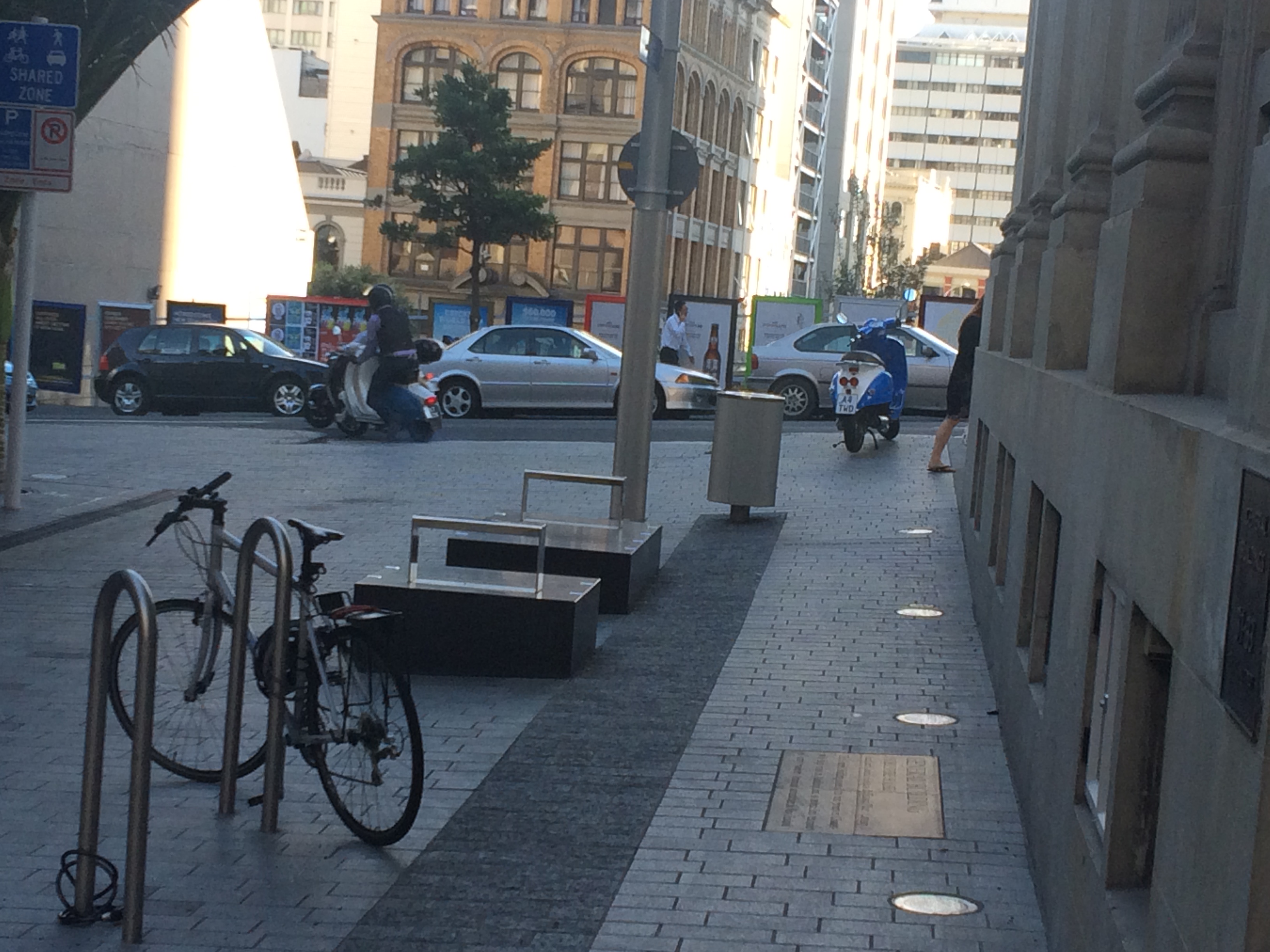
As an experiment I cancelled my permanent carpark before Christmas 2014 and put a piece of card on my garage wall to record my daily commute in 2015 with three options: Scooter, Bike or Car. I also kept a running tally of carpark costs.

My commuting bike is an e-bike – which means it’s electric assist. I can go along about 10-15 km/h quicker for the same effort than a standard bike will do. Speed is an advantage and it’s excellent in the wind and on hills. In theory you can ride it without pedaling but it doesn’t go that quickly on anything other than the flat, and in any event not for long. Another advantage for me is that I can commute in business attire and although I’m warm (and wide awake!) when I arrive at work, there’s no need for a shower.

My scooter was a 50cc moped at the beginning of the year. I found the Scooter more challenging than the bike. I found car drivers treated the scooter as simply another motor vehicle, with unrealistic expectations of acceleration and speed. On the bike, my experience has been most motorists are considerate and respectful of the cycle’s limitations and your vulnerability. Of course there are exceptions and I could write a blog or three about that!.

I recently upgraded the scooter to a much more powerful machine requiring a motorcycle licence, and now my Driver Licence is clearly marked “Learner”.

During the year the daily rate for parking went up from $13 to $17 so that had an impact on the days I took the car. Other factors included a rule that if it was raining I wouldn’t start the journey by cycle – that rule went by the wayside once I got some excellent rainproof gear from Europe – and I wouldn’t take the scooter if it was going to rain.  With the new scooter I don’t worry about the rain at all.

IMG_4810Ignoring the statistics, my recollection of the year was that the preferred form of travelling by far was the e-bike, especially with the Grafton Gully cycleway opening and more recently, Te Ara I Whiti, the Nelson Street cycleway with the striking “blood of the Totara” coloured surface. I frequently used the bike to go to clients, to personal appointments, and to do errands after work. It has a range of about 40 km on one charge, and I ran out of power once I think, quite close to home.

When I got my new scooter the e-bike took a back seat. Maybe it’s the newness, but it was first choice for the weeks before Christmas after I got it. Like the e-bike, I can use the bus lanes, generally get to the front of the traffic queue if required, and parking is free, right next to the office.

I used the car when I had to take someone somewhere, needed to go somewhere where the bike couldn’t easily go, such as over the Shore, or on occasion when I was very tired.

Not counted in the stats is the use of the car or a taxi to the airport when travelling – which accounts for many of the missing days in my tally. The other missing days are leave and public holidays.

So where did it end up?: The scooter was used for 37 commutes, the car for 50, and the e-bike for 68. I also recorded a lonely 1 for “bus”.

Overall, two wheels combined beat the car 2:1. I spent $917 on parking which was less than half the amount I would have paid for the permanent carpark. And there were other costs – charging the e-bike costs about 1.2 cents a time – yes you read that right!, and having a second vehicle costs a vehicle licence and insurance.

Reflecting on all of this, twice in the last week I’ve taken my road bike up the northwestern cycle lane next to the motorway. A great cycling route. As anyone that goes out that way will know it’s about 15km of motorway reconstruction. Some of it looks so wide it must be 10 or 12 lanes all up, which I imagine will include bus lanes. The signs promise “More lanes by 2017”.

Roading infrastructure is important and we’ve been behind in New Zealand for a long time. But there will be a limit – roads that were relatively recently expanded become jammed up and there’s little doubt that New Zealand cities are moving to more public and self transport options as priorities ie non-car!  The experience in other countries which I have seen first hand convinces me it’s the right move for a much more liveable city.

Even if you don’t consider cycling for any altruistic reason, I’m pretty confident that cycling once or twice a week will have most people smiling at the enjoyment and health of it as a commuting option.

Two things make the cycle the number one choice for me: the movement – I’ll call it that rather than exercise – the e-bike is not what I’d call a workout,  that’s what my road bike is for – and the alertness required (which also applies to the scooter). I arrive at work much more energised and connected. And with all the other friendly commuters to chat to at the lights there’s a real sense of community.

Now a final note on safety.  Mum would feel much better if I kept to the car – she’s said so. Don’t charge out up Great South Road, or Dominion Road on the first strike out. Take it easy with some trial runs on a Sunday morning and let the confidence build up. Get lights, a high-vis vest, a mirror for commuting, a horn,and assume that no-one sees you. Mum will worry less then!

Stephen

Temporary

Its seems like just the other day  I was returning from Europe, although it was over two months ago. I’d been saying that as soon as Boxing Day (or St Stephen’s day as it also is!) arrives, I’d be happy. Christmas day arrived, I was well prepared with a  nicely decorated tree thanks to my son Thomas and his wife Dannii, and I had gifts for everyone I needed to. It felt quite relaxed. Work too, is under control (I think).

So some time off which stretches out, but isn’t long at all, although it’s always after Christmas. Which creates a buffer of sorts at the beginning of the holiday to hold the holiday proper out just a little bit before it begins.

Christmas

Christmas as a boy was a very large tree with dozens of presents, the family car well polished, a trip to Dad’s boss’ house for a drink, a chicken roast and a lazy afternoon with new things. Those Christmas’ always had a familiar ring about them but they were temporary, or passing. There have been recent Christmas’ with visits to grandparents and great grandparents who were laid to rest at Waikumete Cemetery.  That was a norm for a few years for me. It stopped this year with a different Christmas morning.

Christmas day is a special day for me. Each time is different, but always special in its own temporary way.

The memories we create from any shared event are those that give the joy beyond the day. It might be that someone or some people weren’t at your Christmas this year and that left a gap. But the day is the day. Reflecting on my day, which started differently for logistical reasons, it was a great day and brings me happiness to think about it.

I won’t try and do the same next year – it might happen – but I won’t be bothered how the day pans out. As long as there’s family and friends, an unseasonably hot roast and a couch to snooze on at in the afternoon, it’ll be perfect.

Knowing that, for once, I’m almost looking forward to it!


Stephen

#7 Leadership

When Richie McCaw announced his retirement from Rugby today it was in the same matter of fact and calm way in which he has led the world of rugby for what seems like forever.

I didn’t think I would but I felt quite sad. He’s become so intertwined with the All Blacks that even when he wasn’t on the field, somehow we knew he was there. It feels like a loss.

His leadership has been remarkable – from the front, never giving up, calm and resolute in the face of incredible aggravation, determined – the best role model you could ever hope for.

I said a couple of years ago to someone “you know, we’re in a golden era of Rugby right now”.  And we were, and I hope we still are!

It’s been an amazing ride to be on and I didn’t realise until today quite how important McCaw has been to my own enjoyment of the game. He didn’t just sneak the ball out of the ruck. He sneakily led us all along on a great journey with a climatic end at Twickenham. I was very honoured to see the All Blacks play a few weeks earlier at Olympic Stadium in London. I’m very glad I did, especially now.

Thank you is what to say to Richie McCaw. Every leader can take so much from you, including things we don’t even understand yet, but the results of your leadership are there for us all to revel in. Achievements that will go down in history. And the best Rugby ever!

Stephen

Back on the streets

After a month in Europe it was great to back on the bike to and from work. I don’t cycle every day, but I try for three times a week. It’s 9 kilometres give or take, half or which is on dedicated cycle lanes and half on a bus lane. Cycling on a bus lane is not for the faint-hearted, but I’ve only had good experiences with buses – it’s the cars that cross or enter the lane who create challenges.

Rush hour in Copenhagen

I had an impression that cycling in Berlin and Copenhagen would be quite special. It was. But not just for the infrastructure – I’ll come back to that shortly – but for the attitude of the residents. A cycle lane means a traffic lane for cycles that you respect as you would another lane of traffic – more so in fact because cyclists are obviously vulnerable – not a nuisance or barrier for ‘real’ traffic (as can often be the local experience). Cyclists are sensible too – not aggressive to each other or other road users – but like most traffic in Europe they move with intent. One of my sisters said that she’d be too timid to cycle on a cycle lane in Copenhagen – too busy she said – and she’s right, it is busy.

Some streets are just made for cycling

I found it invigorating to be cycling with so many like-minded people. And it’s not just the hardy or lycra- wearing (of which there were very little). But parents picking up their children after day care, business people commuting and Seniors getting around doing their shopping. Many apartments appeared not to have car parks in Copenhagen, but there were lots of cycles parked everywhere. A different normal.

Auckland has much to offer cyclists. Just get out there and do it!

Now Auckland is not flat like either of those two cities so there are challenges for cyclists (which e-bikes solve quite easily). Copenhagen was anything but a cycling city in the mid 1960s but decisions made to retrofit cycling infrastructure and prioritise roads for cyclists made it what it is. And there’s lots of signs of on-going improvements and changes to this day.

We’re at a tipping point in Auckland with some fantastic projects completed and underway which have the potential to transform the use of cycling as a viable means of transport. Normalisation and attitude changes to embrace commuters on cycles will hopefully follow. That’s when the tipping point will have been realised.

So why bother? It’s clean, healthy, reduces the need for roads to be built and above all else (if you want to be selfish), it’s so much fun! And being joyful is as good a reason as any to get on that bike. If you haven’t tried it for a while, I bet you’ll be smiling in no time. Chances are it will be faster than the car.

And what’s this got to do with leadership: You’ll start and finish the day in a much better mindset and it feels an authentic and connected way to move around. A virtuious cycle you could almost say!

Stephen