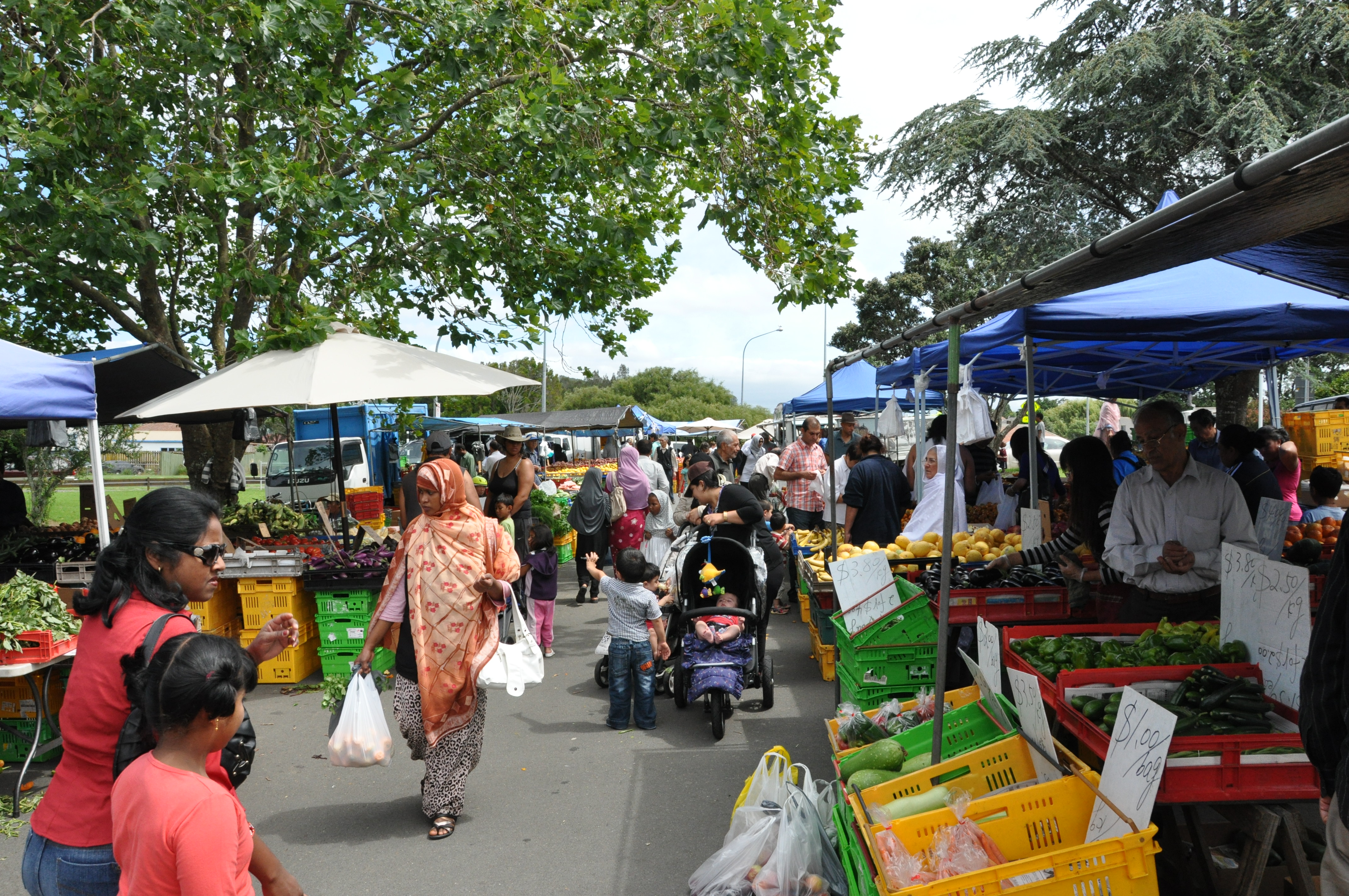
I had finished an appointment in town and instead of a stressful drive on the Southern Motorway to my office in Manukau, decided to cruise down Sandringham Road to Highway 20, which always seems more relaxing (I wonder: has the Queen ever been driven to the intersection of St Lukes and Sandringham Roads where the sign directs you left to Balmoral and straight-ahead to Sandringham?!). At the Wesley Community centre I came across a colourful and bustling market, prompting me to stop, grab the camera and have a look around.
A terrible tragedy has struck in the heart of Moscow. A suicide bomber declaring “I will kill you all”, detonated a large bomb, killing, well not all but 35 and maiming scores. In the weekend, a woman’s body was found burning on the side of the road near Huntly, after what appears to have been a so-called “honour-killing”. It may or may not be the case here, but whatever the circumstances are, such a terrible thing, does exist. Last week a couple in their sixties were subject to a cruel and cowardly attack in small-town New Zealand, because of their sexual preference. Like something from the small-church USA who picket gay funerals.
In our leadership work much of the growth in leaders comes form understanding, challenging and seeking to change leaders’ mental models. Compared to a suicide bomber or “honour” killer, the subject matter can seem pretty insignificant. But what happens during our life’s experiences will shape us and cause us to interpret things in a certain, blinkered way. It’s our way of making sense of the world. And we put up with some of it because “that’s the way they are” or “you need to be careful that you approach her this way” or whatever.
As I walked to the market a polynesian church service was underway inside the community hall. A chinese man, struggling to do his sales pitch to a couple who’s mother-tongue was something else too, was selling tools, gas cookers and an assortment of bathroom fittings. So reasonably priced, I soon found myself the proud owner of a trademan’s filler gun. Just had to have it. Fruit for Africa – in fact some of the locals may have originally been from Africa – second-hand clothes and cheap DVD players. It was a colourful and vibrant scene. And the sense was of tolerance of culture and perhaps belief.
We can delude ourselves with tolerance though. Some things are just not right and we should never forget it and how that they came to be. Our species has only been around for 100,000 years. If the existence of planet earth was a 24-hour clock then our time on it is only a few seconds. So what? I reckon this can put into perspective a claim of “culture”, “ancient belief” that justifies behaviours, some that are tragic. That is, some other guys (mainly) and girls came up with these ideas in quite recent history. Like everything to do with man. Recent, really.
I hope that you are as offended as I am by the examples of behaviours that are driven from some part of human culture. If we want to make it to 200,000 years we need to keep demanding of ourselves that any behaviour that causes harm to another because of some belief held as true, be stomped out. And this might include less dramatic behaviours than murder of course.
Otherwise, are we any better than those sick men in my culture that murdered the women as witches in the not too distant past?
Be tolerant, but not of deluded beliefs that fuel tragedy. Ever.
Stephen

 Ambiguity of expectations, lack of clarity on results, conversations that leave the leader wondering at best, confused at worst.
 Stephen Drain's Leadership Blog