A run for Lloyd

In August 2000 I let my house in Orakei to a lovely, funny and very clever man called Lloyd Lang. Lloyd was a psychiatrist and although I didn’t want any dogs in the house, for some reason it seemed like the right thing to do so he moved in with his dogs. I became friendly with Lloyd and one day when he said how much he liked the house, I said well buy it then. And he did. Having Lloyd in that house, where Tom and Tim had spend 7 years as young boys, kept a connection going. It’s difficult to explain but it’s been a good thing for me.

Exactly two years ago I was at the Polynesian spa in Rotorua on the evening before the Rotorua Marathon when the unmistakable sound of Lloyd and a local doctor friend came to my attention. Lloyd completed the 10k event in the hour he had hoped and on the evening after we went for a Thai dinner. I don’t reckon anyone has entertained my Tim more at dinner than what Lloyd did that night. Tim still remembers it. “Twenty dollars!” he cheerfully offered to any of us and selected waiters for guessing his favourite song, his favourite food and a range of other random thoughts.

Today I left the workshop we were running to attend Lloyd’s funeral. He died on Sunday from cardiac arrest. I knew he had had surgery and he had told me once recently he wasn’t great. When I last saw him a couple of weeks ago he introduced me to his new lady Amber. He was clearly happy.

I’ve never been to a Jewish funeral before and was surprised at the ritual and speed. I’m glad that I shovelled some soil into Lloyd’s grave. I put a shovel of soil in for Tim and others for those I knew who were touched by Lloyd but didn’t make it today.

I’ll run the marathon in the morning thinking of Lloyd. Like I am now.

Small comfort to his family and partner right now, but you made the world a happier place Lloyd. Thank you.

His favourite song? “I did it my way”, by Frank Sinatra.

Stephen
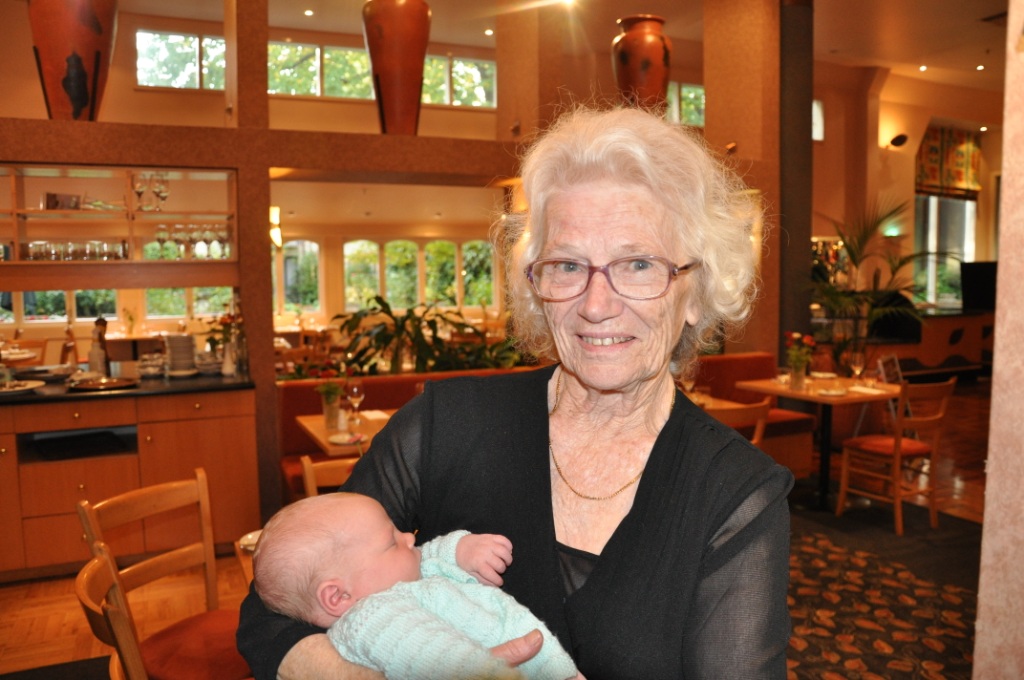
Mother

On her Facebook page she used to describe herself as Retired. Recently my mother changed it to Mother. I felt the need at her 80th this weekend to apologise for her having to come out of retirement for us kids! Born in the depression in Auckland to parents who ran a fish shop in the Valley Road shops, Mum went to Dominion Road School and Auckland Girls’ Grammar, leaving to do night school secretarial studies and typing while working for WG Archer Builders. She met my Dad at a church convention and they married in Christchurch in 1952. Lots of children were born from 1953 until 1959 with a gap to 1962 and finally in 1965.

Mum's a great gran now too

She’s a quiet but very determined woman my mother. Excellent with money, super organised: there were bread orders from different dairies on different days of the week, lunches to make or organise the kids to make them, music lessons for all of us, some sports including Tennis, regular church attendance. And, washing, ironing, cooking, baking with tins of biscuits “hidden” under their bed so we didn’t eat them all at once! We were never hungry or lacking in warmth or clothing. There are times when you look back at your childhood and forget your parents – well certainly in my case – were very young when we were growing up. By the time Mum was 30 she had 5 children. Time can fool you into believing that the wisdom they now hold is precisely what they had when you were young. Maybe Mum did, but I reckon she, like most young people, learned it on the job. So the wise 80 year old I’m in Christchurch now to celebrate the birthday for, got there by trial and error. Experiential learning we call it and if we’re wise too, we recognise that growth comes from failing at times. And giving it a go.

Which is what Mum certainly did in 1970 when she enrolled into the University of Canterbury and completed a BA and Diploma in Teaching. Teaching the dysfunctional girls at Kingsley Girls’ Detention Centre was probably not a big stretch from us 7! Some of the girls achieved School Certificate pass for the first time in the history of the centre under Mum. When I was sick from school I would sleep in the back of her Triumph Herald in Hereford Street while she attended lectures. Morning Teas were at the university cafeteria – now Dux de Lux restaurant. This is all now the Arts Centre and seriously damaged from the 22 February quake. Time can do many things to your perceptions of the past – it can at times make you regret, it can rose-tint actual events and it can make you angry, if you believe something did or didn’t happen that was outside your control.

I count myself as extremely fortunate to have active reflection with my Mum and learn about her life, my life and those around us.  She taught me to respect but be cautious of so-called authority and of different perceptions (see the link below – it’s exactly sums it up about draft vs breeze – but not the rest!). You really can’t ask for more than that. Or can you? At Mum’s birthday celebration yesterday I was privileged to take the role of MC and talk of Mum’s life. To be able to publicly speak of Mum – facts and figures including a family tree going back to the Vikings, being born 10 weeks after the Napier earthquake, the early life in Auckland, marriage, family, study and career.  But what really made it was being able to express the personal memories and connections in front of so many family members that mattered. I never expected this to be the rich experience that it was. Such experiences leave you with a contentment that is difficult to describe.

On our leadership programmes we challenge the participants “What makes you a leader?”. Sometimes you really do find out.

Thanks Mum. You can retire again!

Stephen

Like me, Mum enjoys a good laugh and Seinfeld!.

Talking past

The Blackberry wasn’t talking to the computer according to John Lee, the very helpful IT man at the Campus today. Apparently, it’s not uncommon he said – it’s like they’re both talking in broken English and bits of communication are going back and forth but the full meaning isn’t getting through.

In the movie Sarah’s Key you hear English, French, Italian and  German. It’s a holocaust story of the French sending 76000 Jews out of France to Germany and Poland in July 1942. We all know what happened to these people.

One little girl survived and this is the story of Sarah. Even though there was a lot of different languages, everyone seemed to understand what they needed to, including us at the theatre. Much greater issues were at play in this story, however, and we recoil in horror at the separation of mothers, fathers, children. What would we do now it was asked at one point ? “I’d probably just sit there and watch it on TV like I watch the bombings of civilians in Iraq or Afghanistan” volunteered one young man.

John managed to “force” the contacts back into the system so I haven’t lost them and when the Blackberry is back I’ll hopefully have them back on the phone. 

Communication is fundamental to leadership and at times I’ll either underdo to empower or overdo it to make sure it’s clear (or maybe I’m anxious about the result!). Clarifying the important communication to avoid doubt seems sensible.

Are we watching what’s happening around us? Watching the miscommunication and misunderstandings? Or maybe we’re forcing our language through, when we sense it’s not getting through.

Leading through clear and transparent communication. That’s a great way to start the day. And you never know what you might learn. Like that John Lee’s grandparent’s originated from southern China, and there was a connection to Malaysia when it was a British colony. That was probably happening at around the time of the sad story of Sarah. This wasn’t my purpose in writing this blog, but my mind has moved to thinking we really are quite fortunate in this country to be overall, pretty tolerant. Let’s keep it that way.

It’s a well shot movie, of a dark period in our human history.

Stephen

Leadership and reality

If you listen to talkback radio it’s not a pretty picture painted of our country. We’re broke, it feels like a recession, those that can least afford it can afford it even less, crime is rampant.

An opinion poll came out this evening which showed the National Party on 57.5% compared with Labour’s 28%. All of this in the middle of a lot of crises – the earthquakes, the AMI guarantee, South Canterbury Finance, all of which put together are going to leave us no change from $10 billion. Notice how suddenly everything seems to cost in the billions now? When did that happen? We hardly blinked for more than a day when AMI was guaranteed by us for up to $1 billion. A few days later the Treasury produced a report that said government agencies could save $245 million through efficiencies. Seemed to me (slightly cynically!) that if we have $1 billion for AMI, why bother with all the pain of saving $245 million? Or put another way, let AMI fail and there’s a billion saved just like that, or maybe not.

Anyway I digress. Somehow in the midst of all of this the leadership of the government has managed to keep the majority of New Zealand in support. Some people comment that John Key appears genuine, mixes well and tells it as it is. And whatever the crisis him and Bill English keep telling us that this latest 1 or 5 billion will be allowed for in the budget. Seems like we accept that and on we go. I should also observe that those who don’t think John Key is so flash, have become sharply more critical of what they say is a facade.

What exercises my mind in all of this is whether leadership can be so good that we ignore reality, maybe because it’s too much to grapple with, or we think it’s not our problem.

I’m no economist, but $8.5 billion for earthquakes, $2 billion is it for South Canterbury Finance and up to $1 billion for AMI sounds like a lot of money for us. And must put the economy and our lifestyle at serious risk – even if for all the things that we won’t be able to do while resources are directed to Canterbury (all of it!).

Collision course or to the rescue?

Are we turning a blind eye? Do we think that the leadership knows what it’s doing so we keep on supporting? Do we think that a lot of it is out of the leadership’s control? Or what?

I was a teenager in the mid to late 1970s when the Muldoon government borrowed us into oblivion. Yes there were outside forces, such as the oil crisis, and UK joining the EU, but it all seemed to be well, not quite real. Then.

The discussions about political leadership seem to me to be way too superficial for intelligent people (I know some intelligent people who told me!).

We’re in a big financial crisis, living on an expectation that our political leadership, who appear to majority to be reasonable people, have some reality behind the photo opportunities.

Why do I keep thinking “I hope they know what they’re doing”. Is your organisation like this?

Stephen